
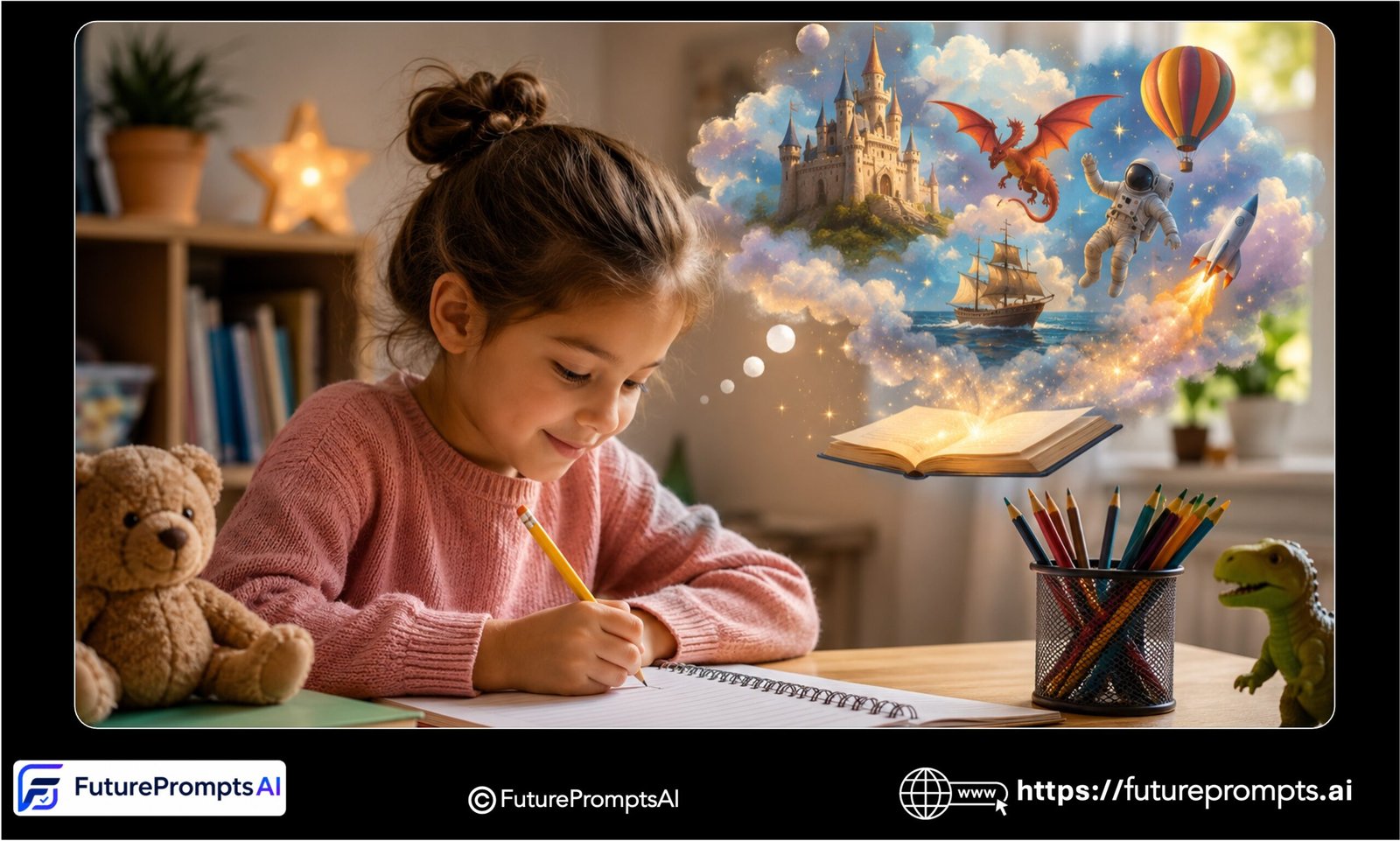
10 Writing Prompts for Kids
Encourage imagination, storytelling, vocabulary development, and confident writing with this collection of 10 detailed AI writing prompts for kids. Each editable prompt includes clear instructions, customizable placeholders, age-appropriate activities, creative story elements, and educational follow-up questions.
Ideal for parents, teachers, homeschoolers, tutors, young writers, and content creators looking for engaging children’s writing activities.
What This Prompt Pack Does
- Helps children create structured stories, journal entries, mysteries, fairy tales, superhero adventures, and imaginative worlds using detailed step-by-step instructions.
- Supports creativity, vocabulary, reading comprehension, emotional learning, descriptive writing, and storytelling skills.
Tips for This Prompt Pack
- Replace every [bracketed section] with details that match the child’s age, interests, reading level, and preferred story topic.
- For younger children, request shorter sentences and 200–300 words. For older children, increase the word count and ask for more dialogue, description, and complex characters.
How to Use the Prompts
- Copy one complete prompt, replace the editable placeholders, and paste it into ChatGPT or another AI writing tool.
- Read the generated story with the child, then use the questions, vocabulary activities, drawing ideas, and continuation tasks to extend the learning experience.
10 Detailed Writing Prompts for Kids
Help children develop creativity, vocabulary, storytelling, and critical-thinking skills with these easy-to-use AI writing prompts. Replace the words inside [brackets] to personalize each activity for the child’s age, interests, learning level, or school assignment.
1. Create a Magical Adventure Story
Prompt:
Act as a friendly children’s story-writing coach. Help me write a magical adventure story suitable for a [child’s age]-year-old reader.
The main character is a [boy/girl/animal/fantasy creature] named [character name] who lives in [location]. One day, the character discovers [magical object, hidden door, mysterious map, unusual creature, or secret message].
Write a story in which the main character must complete [number] challenges before reaching [final destination or goal]. Include a helpful friend named [friend’s name], a surprising problem involving [problem], and a positive lesson about [friendship, courage, honesty, kindness, patience, or teamwork].
Use simple, imaginative language, short paragraphs, and age-appropriate vocabulary. Include sensory details describing what the characters see, hear, smell, feel, and taste. Add dialogue between the characters and finish with a happy or meaningful ending.
The story should be approximately [word count] words long. After the story, provide:
- A creative story title
- Three new vocabulary words with simple meanings
- One reading-comprehension question
- One idea for drawing a scene from the story
2. Write a Funny Animal Story
Prompt:
Act as a humorous children’s author. Write a funny story for a [child’s age]-year-old about a [animal] named [name] that wants to become a [job, performer, athlete, superhero, chef, teacher, or explorer].
The story takes place in [farm, jungle, city, school, zoo, ocean, forest, or another setting]. The animal has a funny habit: [describe the habit]. During the story, the animal accidentally causes [funny problem] and tries three different ways to fix it.
Include:
- A silly conversation with a [second animal or character]
- A surprising event involving [object or situation]
- At least two funny sound words, such as “SPLASH,” “BOOM,” or “CRUNCH”
- A positive lesson about [trying again, accepting differences, helping others, or believing in yourself]
Use playful descriptions, age-appropriate humor, and easy-to-understand sentences. Keep the story between [word count range] words.
At the end, include:
- A funny title
- A one-sentence lesson from the story
- Two questions the child can answer
- A suggestion for creating a comic strip based on the story
3. Imagine a Day in the Future
Prompt:
Act as a creative writing teacher for children. Help me imagine what one ordinary day might look like in the year [future year].
Write from the point of view of a [child’s age]-year-old named [name] who lives in [future city, space station, underwater town, floating island, or another setting].
Describe the character’s full day, including:
- How they wake up
- What their home looks like
- What they eat for breakfast
- How they travel to school
- What technology they use
- What they learn in class
- What they do for fun
- How they communicate with family and friends
Include at least [number] creative future inventions. Make each invention useful, safe, and easy for a child to understand. Include one small problem caused by future technology and explain how the character solves it.
Use descriptive language and include details about colors, sounds, shapes, movement, and emotions. Keep the writing suitable for a [school grade or age group].
Finish with:
- A title for the story
- A list of the future inventions used
- One invention the child could design
- Three questions about how the future might be different from today
4. Write a Superhero Origin Story
Prompt:
Act as a children’s comic-book writer. Create an exciting superhero origin story for a [child’s age]-year-old reader.
The superhero’s real name is [name], and their superhero name is [superhero name]. They receive their powers after [invent a safe and imaginative event].
Their powers include:
- [power one]
- [power two]
- [power three]
The superhero lives in [city or imaginary location] and must protect it from [villain, creature, natural problem, or mysterious event]. The villain’s goal is to [villain’s goal], but avoid graphic violence or frightening details.
Include:
- A clear description of the superhero’s costume
- A loyal sidekick named [sidekick name]
- One weakness or fear the superhero must overcome
- An exciting but child-friendly action scene
- A clever solution that uses thinking, teamwork, or kindness
- A lesson about responsibility, bravery, or helping others
Write approximately [word count] words using energetic but age-appropriate language.
After the story, provide:
- A superhero slogan
- A costume-design idea
- Three comic-book scene ideas
- One question asking the child what power they would choose
5. Continue an Unfinished Mystery
Prompt:
Act as a children’s mystery writer and writing coach. Create an unfinished mystery story that a [child’s age]-year-old can complete independently.
The mystery begins when [main character’s name] discovers that [missing object, unusual sound, secret note, strange footprints, locked box, or mysterious event] has appeared at [location].
Introduce three possible suspects:
- [suspect one]
- [suspect two]
- [suspect three]
Give each suspect a believable reason for being near the location. Add at least five clues, including one clue that may be misleading. Keep the mystery exciting but not scary, violent, or disturbing.
Write the beginning and middle of the story using clear, descriptive language. Stop just before the mystery is solved.
Then provide a section titled “Now You Finish the Mystery” with these questions:
- Who solved the mystery?
- Which clue was most important?
- Who or what caused the mystery?
- Why did it happen?
- How did the characters feel at the end?
Also include a simple word bank containing [number] useful mystery words, such as “clue,” “suspect,” “evidence,” “secret,” and “investigate.”
6. Write a Story from an Object’s Point of View
Prompt:
Act as an imaginative writing teacher. Write a first-person story told from the point of view of a [toy, pencil, backpack, shoe, book, lunchbox, bicycle, or household object].
The object belongs to a child named [name] and spends most of its time in [location]. The object secretly thinks, feels, observes people, and has its own personality.
Give the object these personality traits: [three traits].
Describe one memorable day when the object:
- Gets lost or misplaced
- Meets another talking object
- Learns something surprising about its owner
- Helps solve a small problem
- Returns home or finds a new purpose
Use “I,” “me,” and “my” throughout the story. Include humorous observations about how humans use the object. Add sensory details and at least three lines of dialogue.
Keep the story suitable for a [child’s age or grade] and approximately [word count] words long.
At the end, include:
- A creative title
- The object’s favorite and least favorite things
- Two questions about the object’s feelings
- A writing challenge asking the child to choose another object and continue the idea
7. Create a New Planet
Prompt:
Act as a children’s science-fiction writer and creativity coach. Help me create an original planet called [planet name].
The planet is located [describe its location in space] and has [number] moons. Its sky is [color], its land is covered with [type of landscape], and its weather includes [unusual weather].
Describe the planet in separate sections:
- Appearance: Colors, land, oceans, mountains, clouds, and sky
- Living Creatures: What they look like, eat, and how they communicate
- Plants: Their shapes, colors, special abilities, and uses
- Homes: Where the inhabitants live and what their homes are made from
- Transportation: How people or creatures move around
- Rules: Three important rules everyone follows
- Celebration: One special holiday or festival
- Challenge: One environmental or community problem the inhabitants must solve
Use imaginative but child-friendly descriptions. Include one main character named [name] who has just arrived on the planet for the first time.
Write approximately [word count] words. Finish with:
- A planet fact file
- Three drawing ideas
- Five descriptive vocabulary words
- A question asking the child how they would survive on the planet
8. Write a Kindness Story
Prompt:
Act as a social-emotional learning teacher and children’s author. Write a realistic story that teaches the importance of kindness.
The main character is [name], a [child’s age]-year-old student who attends [school or class name]. At the beginning, the character notices that [another child’s name] is experiencing [a child-friendly problem, such as feeling left out, losing a school item, being new, struggling with an activity, or sitting alone].
Show how the main character:
- Notices the other person’s feelings
- Thinks about what to do
- Offers help in a respectful way
- Faces a small challenge or misunderstanding
- Learns that kindness can affect more than one person
Include natural dialogue, realistic emotions, and details children can relate to. Avoid making the lesson sound like a lecture. Show the lesson through the characters’ actions.
Write for a [child’s age or grade] reading level and keep the story around [word count] words.
After the story, include:
- The main kindness lesson
- Three examples of kind actions
- Two discussion questions
- A simple kindness challenge the child can complete today
9. Write a Personal Journal Entry
Prompt:
Act as a supportive children’s journaling coach. Help a [child’s age]-year-old write a detailed journal entry about [event, experience, holiday, school day, family activity, achievement, challenge, or special memory].
Begin by asking the child these five simple questions:
- Where did the event happen?
- Who was there?
- What happened first, next, and last?
- How did you feel during the experience?
- What did you learn or remember most?
After the child answers, organize the information into a first-person journal entry using “I,” “me,” and “my.”
The journal entry should include:
- The date
- A strong opening sentence
- Events in the correct order
- Descriptions of sights, sounds, smells, tastes, or feelings
- At least two emotion words
- A reflection about why the experience mattered
- A final sentence about what the child hopes will happen next
Use natural, age-appropriate language while keeping the child’s original ideas. Do not invent important personal facts that were not provided.
After the journal entry, suggest:
- One possible title
- Three stronger vocabulary words
- One related drawing idea
- One follow-up journal topic
10. Invent a New Fairy Tale
Prompt:
Act as a modern children’s fairy-tale writer. Create an original fairy tale for a [child’s age]-year-old reader.
The story takes place in [enchanted forest, hidden kingdom, magical village, castle in the clouds, underwater palace, or another setting].
The main character is a [child, animal, royal character, magical creature, or ordinary villager] named [name] who wishes for [wish or goal]. To achieve the goal, the character must find [magical item] and complete [number] tasks.
Include:
- A wise helper named [name]
- A magical creature with a surprising personality
- A rule that must not be broken
- A difficult choice between two options
- A magical transformation
- A positive lesson about [honesty, generosity, courage, gratitude, patience, or being yourself]
Use traditional fairy-tale elements while giving the story an original setting and characters. Include rich descriptions, simple dialogue, and an ending that clearly shows how the character has changed.
Write approximately [word count] words.
After the fairy tale, provide:
- A memorable title
- The lesson or moral
- Three magical objects from the story
- A new ending idea the child could write
- A prompt for illustrating the story’s most magical scene


About author


Add comment