
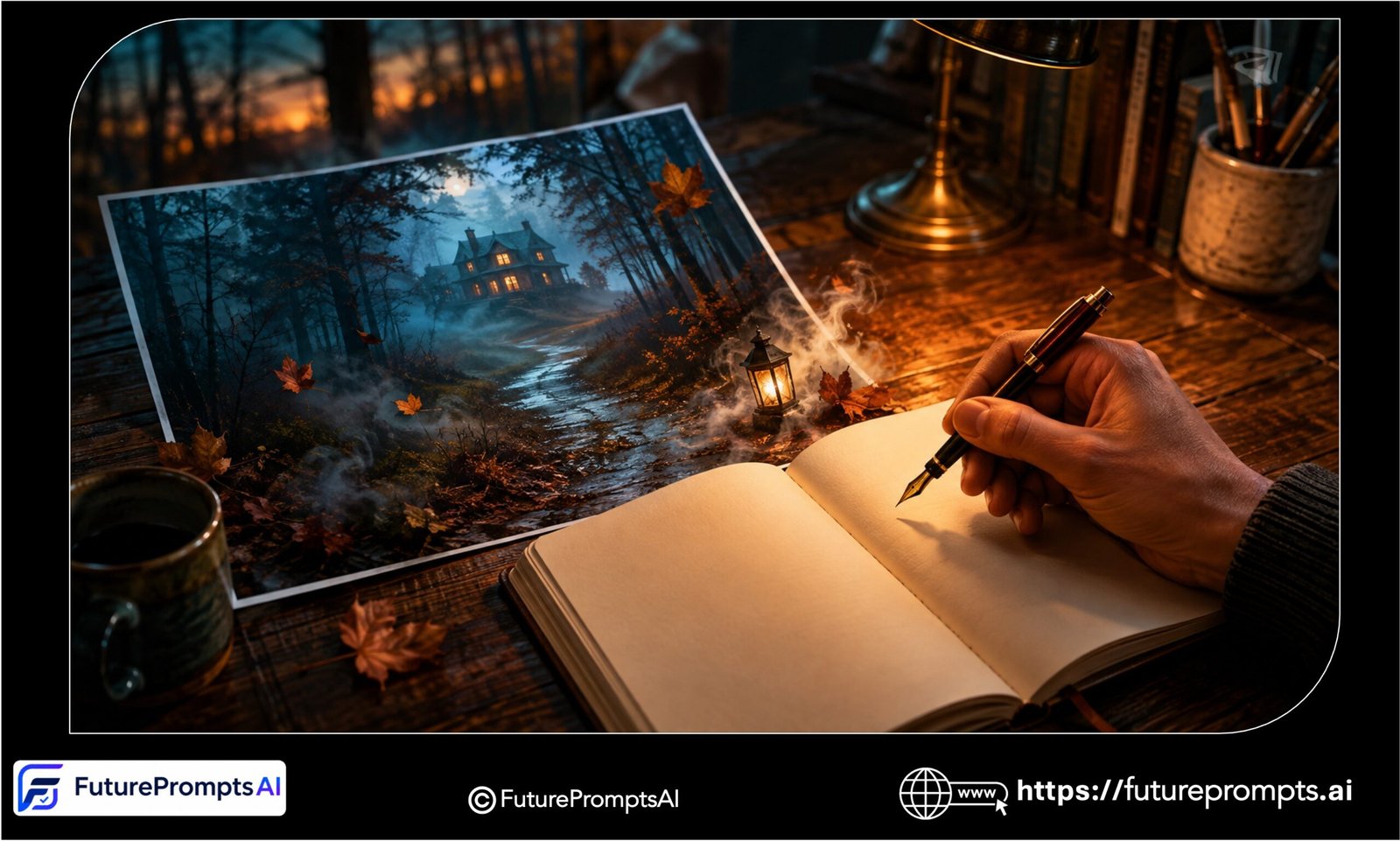
10 Picture Prompts for Creative Writing I AI Story Prompt Pack
Turn any image into an original story with 10 detailed, customizable AI prompts. This creative writing pack helps you develop cinematic openings, layered characters, visual mysteries, dialogue scenes, sensory memories, dual viewpoints, genre variations, and twist-ending flash fiction from photographs, illustrations, paintings, or AI-generated art.
What This Prompt Pack Does
- Converts visual details into structured story elements—including characters, conflict, setting, dialogue, clues, emotional arcs, and endings—instead of producing vague image descriptions.
- Provides 10 distinct creative-writing frameworks with editable fields, clear output requirements, and built-in craft guidance for more focused, useful AI-generated results.
Tips for These Prompts
- Choose a picture with a clear subject, setting, or unusual detail; stronger visual clues usually create richer characters, conflicts, and story possibilities.
- Replace every square-bracket field before submitting, then ask the AI to revise one element at a time—such as voice, pacing, tension, or length—without changing the details you want to keep.
How to Use the Prompts
- Upload or attach a picture to an AI tool with image-viewing capability, copy one prompt, and replace the customizable text in square brackets with your choices.
- Submit the completed prompt, review the result, and continue the same chat with focused directions such as “increase the tension,” “make the dialogue more natural,” or “expand this into chapter one.”
10 Picture Prompts for Creative Writing
Turn any photograph, illustration, painting, or AI-generated image into a strong piece of creative writing. Upload a picture to an AI tool that can view images, choose one prompt below, replace the text in square brackets, and paste the prompt into the same conversation.
1. Write a Cinematic Opening Scene
Customize: [genre], [tone], [point of view], [tense], [main character], [word count]
Study the attached picture closely and use it as the opening frame of a [GENRE] story with a [TONE] atmosphere. Write in [FIRST PERSON / THIRD PERSON LIMITED] and [PAST / PRESENT] tense. The viewpoint character is [MAIN CHARACTER: name, age, role, and one defining trait].
Begin with a vivid action, discovery, or disruption already in progress—not a general description of the image. Integrate at least five concrete visual details from the picture naturally through the character’s movement, attention, and emotions. Establish where the character is, what they want in this moment, and what prevents them from getting it. Introduce one visually inspired object or detail that appears ordinary but may become important later. Include a brief line of dialogue or internal thought that creates a question in the reader’s mind.
Do not explain the entire backstory or reveal the main threat. End the scene with a change, arrival, sound, message, or realization that forces the character to act.
Write approximately [WORD COUNT, e.g., 700] words. After the scene, add:
- “Story Question” — the central question created by the opening.
- “Possible Next Move” — one sentence suggesting what could happen next.
2. Discover What Happened Before and After the Picture
Customize: [genre], [time gap before], [time gap after], [protagonist], [emotional arc], [word count]
Treat the attached picture as the exact middle moment of a [GENRE] story. The protagonist is [PROTAGONIST: name, role, motivation]. Their emotional arc should move from [STARTING EMOTION] to [ENDING EMOTION].
First, silently identify the visible people, objects, setting, lighting, body language, and signs of recent activity. Then invent a connected three-part narrative:
PART 1 — “[TIME GAP BEFORE, e.g., Twenty Minutes Earlier]”: Show the choice, mistake, promise, or discovery that led directly to the pictured moment.
PART 2 — “The Moment in the Picture”: Re-create the image as a live scene using action, sensory detail, and the protagonist’s thoughts. Include at least four recognizable details from the picture without listing them.
PART 3 — “[TIME GAP AFTER, e.g., The Following Morning]”: Reveal the consequence of what happened in the pictured moment.
Use one recurring object from the image as a symbol whose meaning changes across the three sections. Make cause and effect clear, keep the characters’ behavior believable, and avoid resolving the conflict too easily. The final line should echo an image or phrase from Part 1 but give it a new meaning.
Total length: approximately [WORD COUNT, e.g., 1,200] words.
3. Build a Character from a Face, Figure, or Silhouette
Customize: [character name], [genre/world], [age], [secret], [desire], [voice style]
Use the main person, figure, or silhouette in the attached picture as inspiration for an original character named [CHARACTER NAME], age [AGE], living in [GENRE OR STORY WORLD]. Do not claim to identify the real person in the image. Treat visible details only as creative starting points.
Infer possible personality clues from posture, expression, clothing, surroundings, and any object the figure is holding or standing near. Then create a layered character whose public impression conflicts with their private reality. The character desperately wants [DESIRE], but is hiding [SECRET]. Give them one admirable quality, one self-defeating habit, one fear they would never admit, and one physical mannerism inspired by the image.
Deliver the result in four sections:
- **First Impression** — 80–100 words describing how a stranger sees them.
- **Private Truth** — 120–150 words revealing what that impression gets wrong.
- **Character Voice** — a 250-word first-person monologue in a [VOICE STYLE: dry, lyrical, nervous, blunt, etc.] voice, spoken immediately before or after the pictured moment.
- **Story Engine** — three specific conflicts that could force this character to confront their secret.
Avoid generic traits. Connect every major trait to a behavior, choice, memory, or consequence.
4. Turn the Picture into a Visual Mystery
Customize: [mystery type], [detective], [setting/time period], [difficulty], [word count]
Create a fair-play [MYSTERY TYPE: cozy mystery, psychological mystery, historical mystery, crime puzzle, etc.] inspired by the attached picture. Set it in [SETTING AND TIME PERIOD]. The investigator is [DETECTIVE: name, role, strength, and personal weakness]. Difficulty level: [EASY / MODERATE / CHALLENGING].
Select six concrete details visible in the image. Use four as genuine clues, one as a convincing red herring, and one as an overlooked detail that unlocks the solution. If part of the image is unclear, turn the uncertainty into a question rather than stating it as fact.
Write approximately [WORD COUNT, e.g., 1,000] words as a complete mystery scene. Open when the investigator notices that something in the setting is wrong. Let them question or interact with at least one other character, form an incorrect early theory, and revise it through observation. Give the culprit or responsible person a believable motive and a reasonable opportunity. Do not rely on coincidence, hidden evidence introduced at the end, or information unavailable to the reader.
After the story, provide a spoiler-marked “Clue Map” listing:
– each of the six image details;
– whether it was a clue, red herring, or key detail;
– what it meant;
– where it appeared in the story.
5. Create a Dialogue-Driven Scene
Customize: [relationship], [conflict], [subtext], [genre], [ending beat], [word count]
Use the attached picture as the location and visual situation for a dialogue-driven [GENRE] scene between two characters who are [RELATIONSHIP: estranged siblings, rivals, former friends, strangers, etc.]. Their immediate conflict is [CONFLICT], but the truth neither wants to say directly is [SUBTEXT OR HIDDEN ISSUE].
Write approximately [WORD COUNT, e.g., 800] words. Start after the conversation has already become uncomfortable. Keep at least 65% of the scene in spoken dialogue, but use short action beats tied to visible objects, distance, posture, weather, or lighting in the image. Give each speaker a distinct rhythm, vocabulary, and avoidance strategy. Let the surface conversation concern one thing while the subtext gradually reveals another.
Include:
– one line that sounds harmless but lands like an accusation;
– one interruption caused by something visible or logically suggested by the picture;
– one lie the reader can detect from behavior;
– one moment when power shifts from one speaker to the other.
Do not use exposition-heavy speeches or dialogue tags that explain emotions. Show emotion through word choice, silence, unfinished sentences, and physical behavior. End with [ENDING BEAT: a reluctant agreement, a departure, an unanswered question, an unexpected confession, etc.] that changes their relationship without fully resolving it.
6. Make the Setting Feel Like a Character
Customize: [setting identity], [mood], [season/time], [traveler], [danger or promise], [word count]
Transform the location in the attached picture into a living, influential presence in a story. The place is called [SETTING IDENTITY OR NAME], the mood is [MOOD], and the scene takes place during [SEASON / TIME OF DAY / ERA]. A traveler named [TRAVELER: brief description and reason for arriving] enters the setting while searching for [GOAL]. The place contains or represents [DANGER, SECRET, OR PROMISE].
Write approximately [WORD COUNT, e.g., 900] words in close third person. Use the picture’s architecture, landscape, light, color, textures, pathways, objects, and signs of human activity as active forces that shape what the traveler notices and decides. Include at least one detail for each sense—sight, sound, smell, touch, and taste—but avoid a static descriptive inventory.
Personify the setting subtly through verbs and patterns, without literally making it speak unless [MAGICAL SETTING: YES / NO] is set to YES. Give the place a history suggested by two visible details. Let one part of the environment help the traveler and another obstruct them. As the traveler moves through the scene, shift the meaning of one image detail from welcoming to threatening, or from threatening to hopeful.
End when the traveler understands that entering this place requires a price, promise, or irreversible choice.
7. Reimagine One Picture in Three Different Genres
Customize: [three genres], [shared character], [shared object], [tone contrast], [length per version]
Use the attached picture to create three sharply different story openings in these genres: [GENRE 1], [GENRE 2], and [GENRE 3]. All three versions must include the same protagonist—[SHARED CHARACTER: name and defining goal]—and the same visible or image-inspired object—[SHARED OBJECT]. The overall contrast should feel [TONE CONTRAST: e.g., eerie vs. romantic vs. absurd].
Before writing, identify five specific visual anchors from the image. Use all five in every version, but change their meaning according to the genre. For example, a distant light could become a rescue signal, an invitation, or a trap. Do not merely swap genre labels or vocabulary; change the type of conflict, pacing, assumptions about the world, and emotional effect.
For each version, write approximately [LENGTH PER VERSION, e.g., 450] words and include:
– a genre-appropriate opening hook;
– a clear immediate goal and obstacle;
– one use of the shared object;
– a final line that creates momentum.
Afterward, add a compact comparison table with the columns: Genre, Central Conflict, Meaning of the Shared Object, Dominant Emotion, and Best Question Raised. Keep the protagonist recognizable across all three versions while showing how genre changes the story around them.
8. Tell the Same Moment from Two Opposing Viewpoints
Customize: [character A], [character B], [relationship], [disagreement], [genre], [word count per viewpoint]
Use the attached picture as one shared moment in a [GENRE] story told by two characters: [CHARACTER A: identity, goal, and mistaken belief] and [CHARACTER B: identity, goal, and hidden knowledge]. They are [RELATIONSHIP], and they disagree about [CENTRAL DISAGREEMENT].
Write two accounts of the same [WORD COUNT PER VIEWPOINT, e.g., 600]-word scene. Version A must use Character A’s first-person voice; Version B must use Character B’s first-person voice. Keep the physical sequence of events consistent across both versions, including at least five concrete details from the picture, but let attention, interpretation, memory, and emotional meaning differ.
Give the narrators noticeably different sentence patterns, vocabulary, and sensory priorities. Include one shared line of dialogue word-for-word in both accounts. In Version A, make that line sound reassuring; in Version B, reveal why it is threatening, dishonest, or heartbreaking. Each narrator should notice one image detail the other ignores. Neither narrator should be completely correct or completely deceptive.
Finish with a 100-word section titled “What the Reader Now Knows,” explaining the key truth that becomes visible only when both perspectives are combined. Do not repeat the scene from an objective viewpoint or settle every uncertainty.
9. Turn a Still Image into a Sensory, Emotional Memory
Customize: [narrator], [age then], [age now], [dominant emotion], [trigger object], [style], [word count]
Treat the attached picture as a memory belonging to [NARRATOR], who was [AGE THEN] when it happened and is [AGE NOW] while remembering it. The dominant emotion beneath the memory is [EMOTION], and the visible or image-inspired detail that triggers the memory is [TRIGGER OBJECT]. Write in a [STYLE: lyrical, restrained, conversational, fragmented, etc.] first-person voice.
Create approximately [WORD COUNT, e.g., 850] words that move fluidly between the present moment of remembering and the past moment shown in the picture. Use at least five visual details from the image, then deepen them with plausible sound, smell, temperature, texture, and bodily sensation. Do not describe all senses at once; let them surface as associations.
Build a gap between what the narrator understood then and what they understand now. Include one detail they remembered incorrectly for years, one sentence spoken in the past that has gained a different meaning, and one small physical action that carries more emotion than an explanation would. Keep the memory imperfect but internally coherent.
End with the narrator returning to the present and making a small choice because of what the picture has helped them finally recognize. Avoid sentimental clichés and do not state the lesson directly.
10. Write Flash Fiction with a Hidden Clue and Twist Ending
Customize: [genre], [protagonist], [apparent situation], [true situation], [tone], [exact word limit]
Write a complete [GENRE] flash-fiction story inspired by the attached picture. The protagonist is [PROTAGONIST: name, role, and urgent goal]. At first, the scene should appear to show [APPARENT SITUATION], but the final revelation is [TRUE SITUATION OR TYPE OF TWIST]. Maintain a [TONE] tone.
Use three specific visual details from the picture as follows:
- one establishes the setting;
- one quietly foreshadows the truth;
- one is misinterpreted by the protagonist or reader.
The story must have a beginning, escalation, decisive choice, and consequence within exactly [EXACT WORD LIMIT, e.g., 500] words. Open with a sentence of no more than twelve words. Keep the cast to no more than three named characters. Plant the twist fairly before the halfway point, but disguise it through context rather than withholding basic facts the viewpoint character would naturally know. Make the protagonist’s decision—not coincidence—trigger the ending.
The final two sentences should reveal or confirm the twist and also change the emotional meaning of an earlier detail. Do not use “it was all a dream,” unexplained amnesia, or a twist based only on a character’s hidden identity.
After the story, add a separate “Craft Note” of no more than 80 words identifying the planted clue and explaining how it supports the ending. Do not count the Craft Note toward the story’s exact word limit.


About author


Add comment