
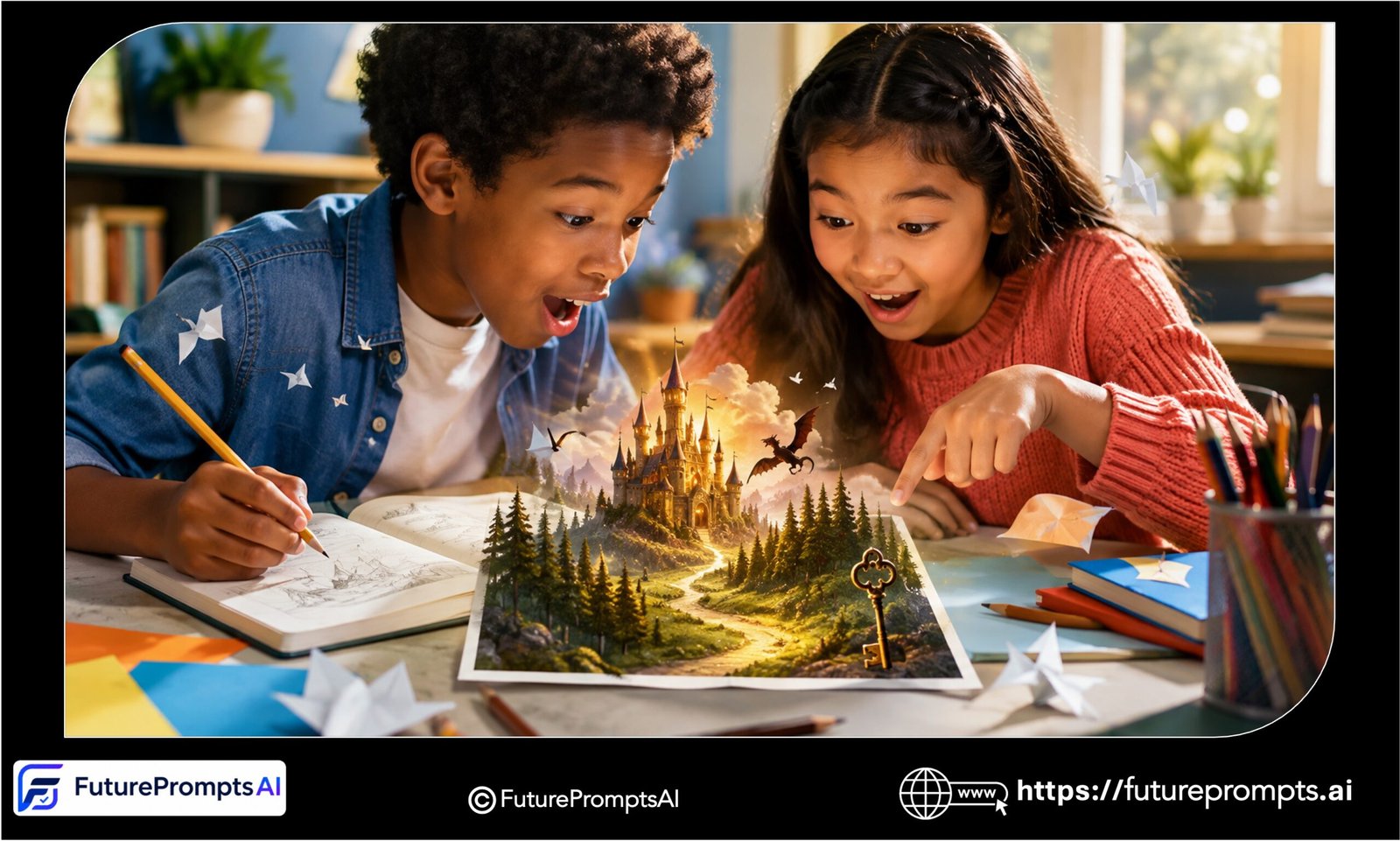
10 AI Picture Writing Prompts for Creative Students
Transform any picture into an engaging writing lesson with this collection of 10 detailed, customizable AI prompts. Designed for students, parents, tutors, and teachers, the pack supports storytelling, description, dialogue, mystery, fantasy, point of view, genre exploration, and revision. Simply upload a picture, edit the bracketed fields, and generate structured, age-appropriate writing guidance.
What This Prompt Pack Does
- Turns uploaded pictures into detailed story plans, character ideas, sensory descriptions, plot twists, writing activities, and revision guidance.
- Customizes the results by grade level, genre, word count, tone, vocabulary level, point of view, and learning objective.
Tips for These Prompts
- Use a clear, classroom-appropriate picture containing people, objects, actions, or background details that students can interpret.
- Personalize every bracketed field and encourage students to change the AI’s suggestions so their final work reflects their own voice.
How to Use the Prompts
- Upload or attach a picture to an AI tool, copy one prompt, and replace all information inside the square brackets.
- Review the generated plan with the student, choose the most useful ideas, and use them as guidance for an original piece of writing.
10 Creative Writing Picture Prompts for Students
Replace the information inside [square brackets], upload or attach a picture, and paste the selected prompt into your preferred AI tool.
Prompt 1: Turn a Picture into a Complete Story Plan
You are a supportive creative-writing coach working with a [student age or grade level] student. Carefully examine the attached picture and help the student develop an original [genre: adventure, mystery, fantasy, realistic fiction, etc.] story.
Use these preferences:
- Story length: [word count]
- Point of view: [first person/third person]
- Tone: [funny, suspenseful, emotional, hopeful, etc.]
- Main writing skill: [plot development/description/characterization/etc.]
- Vocabulary level: [beginner/intermediate/advanced]
First, list five details that are clearly visible in the picture. Then list three possible story ideas inspired by those details. Do not treat guesses about the picture as confirmed facts.
After presenting the ideas, choose the strongest one and create:
- A memorable story title.
- A main character with a goal, motivation, strength, and weakness.
- The setting and its importance to the story.
- A central problem connected to something visible in the picture.
- A beginning, three rising-action events, a climax, and a satisfying resolution.
- Three possible opening sentences.
- Five useful descriptive words appropriate for the student’s grade.
- A short writing checklist the student can follow.
Guide the student without writing the entire story. Make the plan imaginative, specific, age-appropriate, and easy to turn into an original composition.
Prompt 2: Create a Before, During, and After Story
Act as a creative-writing teacher for a [grade level] student. Study the attached picture as if it captures the most important moment in a larger story.
Create a “Before, During, and After” narrative plan based on the picture.
Writing preferences:
- Genre: [genre]
- Main character: [name, age, or short description]
- Mood: [mood]
- Target length: [word count]
- Difficulty level: [easy/moderate/challenging]
- Required lesson or theme: [theme]
Organize the response into these sections:
Before the Picture
Explain where the character was, what they wanted, and which events led to the moment shown. Include one early clue that becomes important later.
During the Picture
Describe the visible moment using sight, sound, movement, and emotion. Identify the decision the main character must make.
After the Picture
Provide three consequences of that decision, followed by a believable ending that connects to the chosen theme.
Then supply:
- A seven-part story sequence.
- Two possible conflicts.
- One unexpected but logical plot twist.
- Four transition phrases for showing time.
- Three opening-sentence choices.
- Two closing-sentence choices.
- Five questions the student can answer to personalize the story.
Keep the ideas closely connected to visible picture details and appropriate for [student age].
Prompt 3: Build a Picture-Based Mystery
You are a mystery-writing coach helping a [grade level] student create an original mystery from the attached picture.
Treat three visible objects, people, or background details as clues. Clearly separate what is visible from what you are creatively imagining.
Customize the mystery with:
- Detective: [name and age]
- Location: [location or “use the picture”]
- Mystery to solve: [missing object/strange message/unexplained event/etc.]
- Tone: [playful/spooky/suspenseful]
- Story length: [word count]
- Reading level: [level]
- Content to avoid: [restrictions]
Develop the following:
- A mystery title.
- The detective’s personality, special skill, and personal reason for solving the case.
- Four suspects, each with a motive and believable alibi.
- Three genuine clues drawn from the picture.
- Two misleading clues that are fair but do not reveal the answer.
- A sequence of six investigation scenes.
- A midpoint discovery that changes the detective’s theory.
- A logical solution explaining how every genuine clue fits.
- A final reveal that is surprising but age-appropriate.
- Five suspenseful sentence starters.
Finish with a clue-tracking table containing the clue, where it appears, what the detective initially thinks, and what it actually means. Do not write the full story unless requested; create a detailed blueprint the student can use.
Prompt 4: Write from a Character’s Point of View
Act as an encouraging writing tutor for a [student age or grade] student. Examine the attached picture and select one visible person, animal, creature, or object to become the narrator.
Use these settings:
- Narrator: [choose one or let the AI choose]
- Format: [diary entry/letter/first-person story/inner monologue]
- Emotion: [emotion]
- Situation: [ordinary/unusual/magical/dangerous]
- Length: [word count]
- Vocabulary level: [level]
- Theme: [theme]
Begin by identifying four visible details that the narrator might notice. Next, create a narrator profile containing their name, personality, goal, fear, secret, and relationship to the picture’s setting.
Develop a first-person writing plan that includes:
- What happened immediately before the pictured moment.
- What the narrator sees, hears, feels, and thinks.
- What the narrator wants but cannot easily obtain.
- An internal conflict and an external conflict.
- One important decision.
- A consequence that changes the narrator.
- A reflective final thought connected to the theme.
Provide three distinctive opening lines, five phrases that reveal emotion without directly naming it, and four questions the student can answer to make the narrator’s voice more personal. Keep the voice consistent and appropriate for the selected grade.
Prompt 5: Create a Dialogue-Focused Picture Story
You are a creative-writing teacher specializing in realistic and engaging dialogue. Help a [grade level] student create a story inspired by the attached picture.
Choose or identify two characters who could naturally belong in the scene.
Customization:
- Character 1: [name and personality]
- Character 2: [name and personality]
- Relationship: [friends/siblings/strangers/rivals/etc.]
- Main disagreement: [conflict]
- Hidden information: [secret]
- Tone: [humorous/serious/suspenseful]
- Story length: [word count]
Create:
- A brief description of what each character wants.
- A reason their goals conflict.
- A scene objective for each character.
- An eight-exchange sample conversation in which each character has a different voice.
- Action beats showing gestures, expressions, or movement between lines.
- One moment of misunderstanding.
- One line that reveals the hidden information.
- A choice that changes the direction of the scene.
- A three-part plan for what happens after the conversation.
- A dialogue-editing checklist.
Ensure the conversation does more than provide information: it must reveal personality, increase tension, and move the story forward. Use punctuation and dialogue tags suitable for [curriculum or regional English style]. Avoid making every line sound the same.
Prompt 6: Develop a Powerful Descriptive Paragraph
Act as a sensory-writing coach for a [grade level] student. Analyze the attached picture and help the student create a vivid descriptive paragraph without producing an excessive list of adjectives.
Use these preferences:
- Mood to create: [peaceful/eerie/joyful/tense/etc.]
- Narrator’s position: [inside the scene/observing from outside]
- Season or time: [setting]
- Target length: [word count]
- Literary techniques: [simile/metaphor/personification/alliteration]
- Vocabulary level: [level]
Complete the following steps:
- Identify six concrete details that are visible in the picture.
- Create a sensory bank containing suitable ideas for sight, sound, smell, touch, and temperature. Clearly label imagined sensory details.
- Select one focal point that should receive the most attention.
- Arrange the description using [left to right/near to far/wide view to close-up].
- Suggest two similes, one metaphor, and one example of personification.
- Provide a topic sentence, three supporting-sentence starters, and a closing sentence.
- Write one short model paragraph at the requested grade level.
- Explain which words or techniques make the model effective.
- Give the student a five-point revision checklist.
The model should demonstrate the technique while leaving enough room for the student to create a different, original version.
Prompt 7: Transform the Picture into a Fantasy Adventure
You are a children’s fantasy-writing coach. Turn the attached ordinary picture into the foundation of a fantasy adventure for a [grade level] student.
Customize the adventure:
- Hero: [name, age, and trait]
- Magical element: [portal, enchanted object, hidden creature, spell, etc.]
- Fantasy world: [world description or “invent one”]
- Companion: [character]
- Villain or obstacle: [description]
- Story length: [word count]
- Tone: [whimsical/epic/mysterious]
- Theme: [courage, friendship, honesty, etc.]
Choose one visible detail in the picture to serve as the entrance to magic. Build a story blueprint containing:
- The hero’s ordinary life.
- The moment the magical detail is discovered.
- Three rules governing the magic.
- A clear mission with meaningful stakes.
- Three increasingly difficult challenges.
- A companion who helps but also creates complications.
- A difficult choice at the climax.
- A resolution showing how the hero has changed.
- One detail from the beginning that gains a new meaning at the end.
- Three fantasy-style titles and three opening hooks.
Conclude with a simple fantasy-world vocabulary bank and five questions the student can use to customize the adventure. Keep the plot coherent; magic should follow the stated rules.
Prompt 8: Tell the Same Picture from Two Perspectives
Act as a creative-writing instructor teaching point of view to [grade level] students. Examine the attached picture and identify two possible narrators who would interpret the scene differently.
Customization:
- Narrator A: [character or viewpoint]
- Narrator B: [character or viewpoint]
- Relationship: [relationship]
- Central event: [event]
- Difference between them: [belief, goal, knowledge, or emotion]
- Length per viewpoint: [word count]
- Tone: [tone]
For each narrator, provide:
- What they notice first in the picture.
- What they want.
- What they know that the other narrator does not.
- Their opinion of the central event.
- The emotion influencing their interpretation.
- Three words or phrases that make their voice distinctive.
- A five-part narrative outline.
- A sample opening paragraph.
Then create a comparison table showing how the narrators differ in voice, observations, assumptions, motivations, and conclusions.
End with three possible truths that readers can discover only by comparing both accounts. The perspectives should contradict each other in interesting ways without making either narrator completely unbelievable.
Prompt 9: Reimagine One Picture in Three Genres
You are a creative-writing coach helping a [grade level] student understand how genre changes a story. Use the attached picture as the starting scene for three different versions:
- Genre 1: [genre]
- Genre 2: [genre]
- Genre 3: [genre]
Additional settings:
- Main character: [character]
- Target audience: [age group]
- Length of final story: [word count]
- Content restrictions: [restrictions]
- Skill to practice: [setting/plot/tone/etc.]
For each genre, produce:
- A suitable title.
- A one-sentence story premise.
- The central conflict.
- How the picture’s setting should be interpreted.
- A genre-appropriate character goal.
- One plot twist.
- A beginning, middle, climax, and ending outline.
- A 75–100-word sample opening.
- Five words or phrases that establish the genre’s tone.
After presenting all three versions, compare how the setting, conflict, vocabulary, pacing, and ending change between genres. Recommend the version that best fits the visible picture and explain why.
Finish with five questions that help the student choose and personalize one version before writing.
Prompt 10: Picture-Story Writing and Revision Coach
Act as a patient writing coach for a [grade level] student. The student is writing a story based on the attached picture and will provide a draft below.
Student’s draft:
[PASTE THE STUDENT’S DRAFT HERE]
Assignment requirements:
- Genre: [genre]
- Required length: [word count]
- Point of view: [point of view]
- Required picture details: [details]
- Learning objective: [objective]
- Areas needing help: [organization/grammar/description/dialogue/etc.]
Review the work in this order:
- Summarize the student’s story in two sentences to confirm understanding.
- Identify three things the student did effectively, citing short examples from the draft.
- Check whether the story clearly connects to the picture and assignment.
- Identify the three most important improvements.
- Ask five specific revision questions that encourage the student to make decisions.
- Suggest improvements to the opening, conflict, climax, and ending.
- Highlight sentences that could be clearer, but do not rewrite the entire draft.
- Show one improved example sentence for each major issue.
- Provide separate checklists for story development, picture connection, grammar, and proofreading.
- End with an encouraging next step.
Preserve the student’s ideas and voice. Do not replace the draft with a completely new story. Explain feedback using language appropriate for the student’s age.

About author


Add comment