
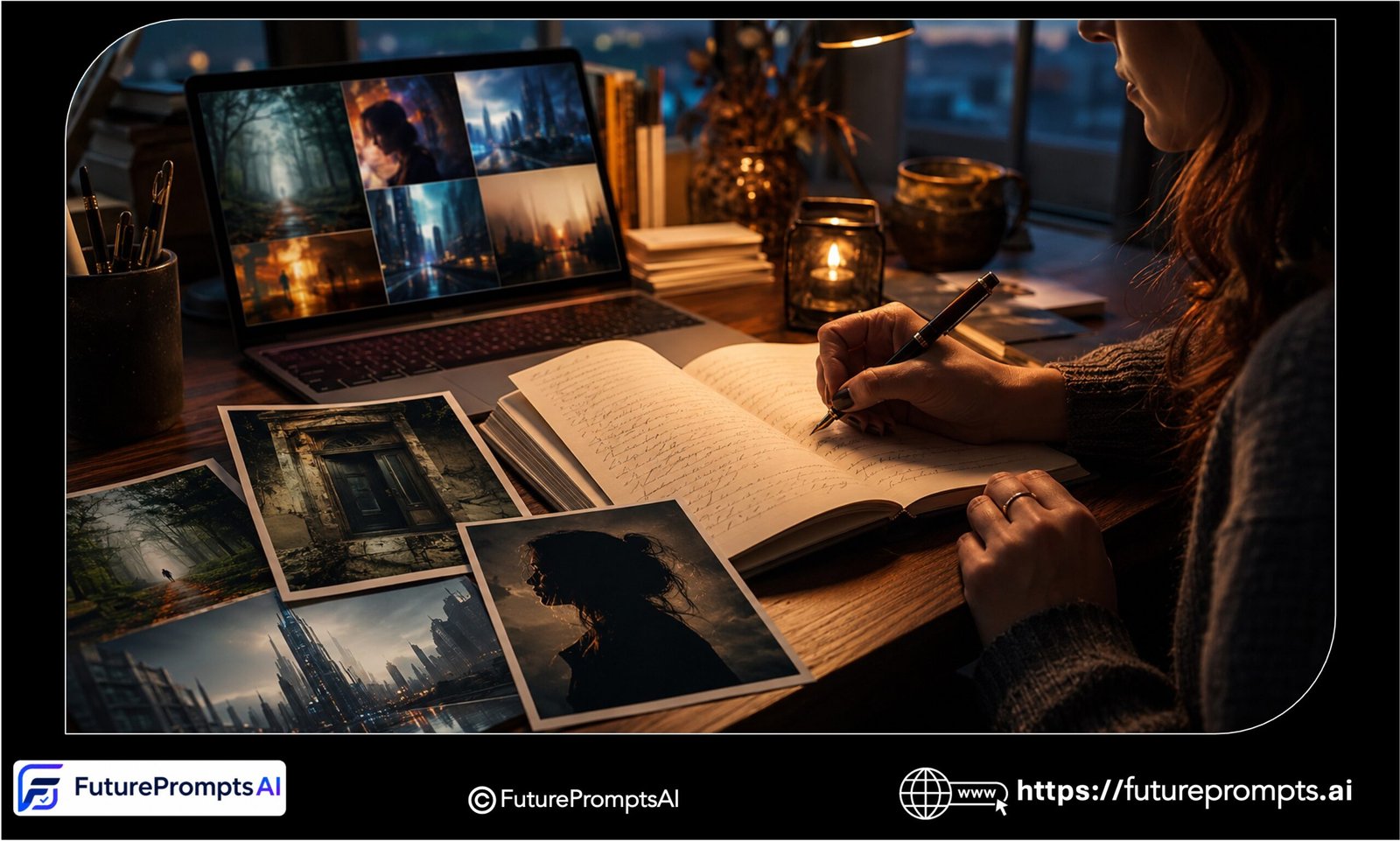
10 Creative Writing Prompts for Adults Using Images
Turn photographs, portraits, places, and imagined scenes into compelling adult fiction with this collection of 10 detailed AI writing prompts. Customize the bracketed fields to create mysteries, literary stories, psychological dramas, magical realism, and speculative fiction with stronger characters, conflicts, and endings.
What This Prompt Pack Does
- Transforms uploaded images or written scene descriptions into structured, original story drafts for adult readers.
- Helps users control genre, characters, setting, tone, length, point of view, conflict, and ending without writing complicated AI instructions.
Tips for These Prompts
- Replace every bracketed section with specific information; precise details usually produce more original and consistent stories.
- Treat the first result as a draft, then ask the AI to improve one element at a time, such as dialogue, pacing, atmosphere, or character motivation.
How to Use These Prompts
- Choose a prompt, replace the bracketed placeholders, and upload a suitable image—or describe the image if the AI tool does not support uploads.
- Paste the completed prompt into ChatGPT or another generative AI tool, review the story, and request revisions that match your voice and intended audience.
10 Creative Writing Prompts Inspired by Images for Adults
Replace the text inside [brackets], then paste the prompt into an AI tool. Upload a reference image when supported; otherwise, describe the image in the designated field.
1. The Secret Hidden in an Ordinary Photograph
Customizable prompt:
Study the attached image—or use this description: [describe the image, setting, people, objects, colors, and mood].
Write a [word count]-word [mystery / psychological thriller / literary fiction] story for an adult audience. The main character, [name and age], notices one small detail in the image that everyone else has overlooked. That detail reveals a secret connected to [a missing person / a family betrayal / an unsolved crime / another secret].
Set the story in [location and time period] and create a [tense / melancholic / unsettling / reflective] atmosphere. Include vivid sensory descriptions, realistic adult dialogue, and subtle clues that become meaningful later. Use a [first-person / third-person limited] point of view.
Build toward a surprising but believable revelation. Avoid clichés, excessive exposition, and supernatural explanations unless they are essential to the selected genre. End with [a twist / an unresolved question / an emotional realization / a moral dilemma].
Give the story an intriguing title and begin directly with the first scene.
2. The Life the Character Never Lived
Customizable prompt:
Examine the attached portrait—or use this visual description: [describe the person’s appearance, expression, clothing, surroundings, and visible objects].
Write a [word count]-word literary story about an unlived life. The person in the image is [character name], a [age]-year-old [occupation] who once chose [major life decision] instead of [alternative path].
On [specific event or anniversary], the character imagines how life might have unfolded if the opposite choice had been made. Alternate between the character’s present reality and the imagined life. Explore adult themes such as regret, ambition, love, identity, parenthood, aging, or sacrifice without becoming melodramatic.
Use [first person / close third person], a [intimate / bittersweet / contemplative] tone, and recurring imagery based on [an object or color visible in the image]. Include one conversation that forces the character to confront what was gained—not only what was lost.
End with a quiet but meaningful decision in the present. Provide a compelling title.
3. The Object With Three Owners
Customizable prompt:
Use the central object in the attached image—or this object: [describe the object, its condition, age, markings, and location]—as the connecting element in a three-part story.
Write approximately [total word count] words for an adult audience. Divide the narrative into three titled sections:
- The object’s first owner in [place and year]
- Its second owner during [historical event, social change, or personal crisis]
- Its current owner in [present or future setting]
Each owner should want something different: [first desire], [second desire], and [third desire]. Show how the object is acquired, lost, inherited, stolen, sold, or discovered. Give each section a distinct voice while maintaining a consistent emotional theme of [grief / hope / guilt / freedom / belonging].
Reveal the object’s full significance only in the final section. Include sensory details appropriate to each period and avoid explaining every connection too early. Finish with one memorable sentence that links all three lives.
4. Portrait of an Unreliable Narrator
Customizable prompt:
Study the attached portrait—or use this description: [describe the subject’s face, posture, clothing, background, lighting, and expression].
Write a [word count]-word psychological story narrated by the person in the image. Their name is [name], they work as [occupation], and they insist that they are innocent of [accusation, betrayal, disappearance, or crime].
The narrator should sound intelligent and convincing at first. Gradually expose contradictions through incorrect details, defensive observations, changes in wording, and reactions from other characters. Do not directly tell the reader that the narrator is lying or mistaken.
Set the story during [interview / dinner party / therapy session / police questioning / reunion] in [location]. Use a [controlled / darkly humorous / claustrophobic / confessional] tone. Include three clues that allow attentive readers to infer the truth.
End when the narrator unintentionally reveals one decisive fact. Add a title that gains a second meaning after the ending.
5. Five Minutes Before Two Strangers Meet
Customizable prompt:
Analyze the attached image—or use this scene description: [describe the public place, weather, time, people, and notable visual details].
Identify two strangers who could plausibly be present in this scene. Create the following characters:
- Character A: [name, age, occupation, private problem]
- Character B: [name, age, occupation, private problem]
Write a [word count]-word contemporary story covering the five minutes before they meet and the first ten minutes after. Alternate between their viewpoints. Give each character a mistaken assumption about the other and a private reason for being at [location].
Their meeting should be triggered by [a dropped object / an emergency / a misunderstanding / a shared observation / another event]. Use natural dialogue, specific visual details from the image, and restrained emotional writing. Let the encounter change one immediate decision for each character without unrealistically solving their entire lives.
Choose a [hopeful / romantic but realistic / humorous / poignant] tone and finish with an understated final image.
6. The Message That Arrived Too Late
Customizable prompt:
Use the attached image—or this visual description: [describe the location, device, letter, person, lighting, and mood]—as the opening scene.
Write a [word count]-word [drama / mystery / romance / speculative fiction] story for adults. The protagonist, [name, age, and occupation], receives a message from [sender or relationship] exactly [number] years/months/days after it was sent.
The message says or implies: [key information]. Explain the delay through [a technical failure / deliberate concealment / legal restriction / time anomaly / misplaced letter]. The message forces the protagonist to reconsider [a relationship, belief, past decision, or unresolved event].
Include the protagonist’s initial reaction, a difficult conversation, and one action with irreversible consequences. Maintain a [urgent / mournful / suspenseful / quietly romantic] tone. Avoid convenient coincidences and exaggerated emotional speeches.
End with the protagonist composing a reply, but reveal only its final sentence. Give the story a strong title.
7. Magical Realism in a Familiar Place
Customizable prompt:
Study the attached everyday scene—or use this description: [describe an ordinary home, street, café, workplace, or neighborhood].
Write a **[word count]-word magical-realism story set in [location and cultural setting]. The protagonist, [name, age, occupation, and personal concern], discovers that [one visual element in the image] behaves impossibly: [describe the magical behavior].
Treat the magical event as unusual but emotionally believable. Do not explain it with science, dreams, or a lengthy mythology. Connect the impossible event to the protagonist’s struggle with [grief / aging / loneliness / identity / family expectations / change].
Use concrete sensory language and include at least two details based on [local food, customs, weather, music, or architecture]. Add one supporting character who accepts the magic and another who refuses to acknowledge it.
Choose a [warm / haunting / whimsical / bittersweet] tone. End with a transformation that may be literal, emotional, or both.
8. The Choice No One Else Can Make
Customizable prompt:
Use the attached image—or this scene description: [describe the location, characters, objects, weather, and emotional atmosphere]—to inspire an adult moral-dilemma story.
The protagonist is [name, age, role or occupation]. They must decide whether to [choice A] or [choice B] before [deadline or event]. Choice A protects [person, value, or goal] but risks [consequence]. Choice B protects [different person, value, or goal] but causes [different consequence].
Write [word count] words in a [realistic / dystopian / historical / legal / medical] setting. Present both options fairly so that neither has an obviously correct answer. Include pressure from [supporting character], a relevant memory, and new information that complicates the decision.
Use [first person / third person limited] and a [tense / restrained / morally complex] tone. Keep the conflict focused on human consequences rather than abstract debate.
End immediately after the protagonist acts, showing one concrete consequence without telling the reader how to judge the decision.
9. A Memory That Changes Every Time
Customizable prompt:
Study the attached image—or use this description: [describe the place, people, objects, colors, and apparent event].
Write a [word count]-word story about a disputed memory. The narrator, [name and age], believes the image shows [their version of what happened]. Another person, [name and relationship], insists it shows [conflicting version].
Structure the story around three examinations of the same image:
- What the narrator remembers at first
- What changes after learning [new fact]
- What the narrator finally notices in the background
Explore how guilt, grief, love, trauma, or self-protection can alter memory. Keep the story psychologically believable and avoid using memory loss as a simple plot device. Repeat one visual detail—[specific object, shadow, reflection, or gesture]—but change its meaning each time.
Use a [haunting / intimate / suspenseful / reflective] style. Conclude with either the most likely truth or a carefully constructed ambiguity. Provide a title that references the recurring visual detail.
10. An Artifact From a Possible Future
Customizable prompt:
Use the attached futuristic image—or this description: [describe the artifact, technology, environment, people, symbols, and condition].
Write a [word count]-word speculative-fiction story centered on this artifact. It was created in [future year] for [original purpose], but its current owner, [name, age, and role], discovers that it can also [unexpected ability or hidden function].
Set the story in a society shaped by [climate change / artificial intelligence / surveillance / longevity / space settlement / another development]. Establish the world through character actions, environmental details, and dialogue rather than a large exposition section.
The protagonist wants [personal goal], while using the artifact could threaten [relationship, community, freedom, or moral principle]. Include one rule governing the technology, one unintended consequence, and one detail showing how ordinary adult life has changed.
Use a [hopeful / cautionary / cerebral / emotionally intense] tone. End with an image that suggests whether the future can still be changed. Add an original title.


About author


Add comment