
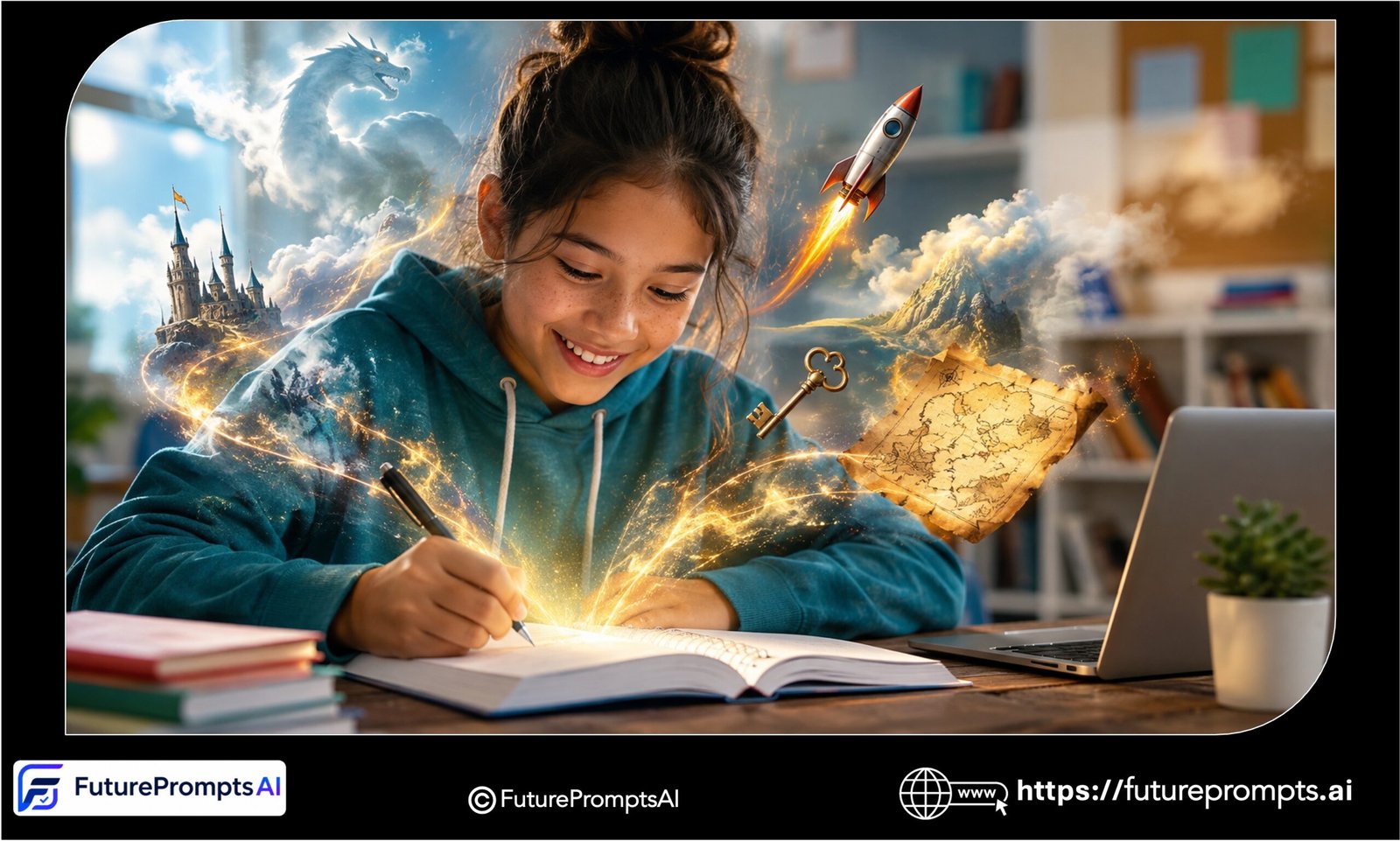
10 Creative Writing Prompts for Middle School Students
Help middle school students transform imaginative ideas into well-organized, original stories with this collection of 10 detailed and customizable AI prompts. The set covers mystery, fantasy, science fiction, realistic fiction, adventure, superheroes, unusual narrators, and more. Students can personalize every prompt by changing the bracketed fields.
What This Prompt Collection Does
- Guides students through character development, setting, conflict, plot structure, dialogue, description, and revision.
- Produces personalized story plans and writing support without asking AI to replace the student’s creativity.
Tips for These Prompts
- Replace every [bracketed section] with specific details before submitting a prompt; specific choices produce more useful results.
- Treat the AI’s response as a brainstorming guide. Change suggestions, add original ideas, and write the final story in your own voice.
How to Use These Prompts
- Choose a genre, customize the bracketed fields, and paste the completed prompt into ChatGPT or another compatible AI assistant.
- Review the generated plan, select the ideas you like, and use them to draft and revise your own original story.
10 Creative Writing Prompts for Middle School
Replace the words inside [brackets] with your own ideas, then paste the prompt into your preferred AI tool. Each prompt helps students develop an original story while keeping them—not the AI—in control of the writing.
1. The Mystery Behind the Locked Door
You are a supportive creative-writing coach for a middle school student. Help me develop an age-appropriate mystery story about [main character’s name and age], who discovers a locked door in [school, library, house, museum, or another location]. The door has not been opened for [number] years, and the only clue is [a strange symbol, note, key, sound, or object].
The story should take place during [time period or season] and have a [funny, suspenseful, spooky-but-not-scary, or adventurous] mood. Include [number] possible suspects, one misleading clue, one important hidden clue, and a surprising but logical explanation.
Give me:
- A strong opening sentence.
- A short description of the setting and main character.
- Three possible suspects and their motives.
- Five clues in the order they could be discovered.
- A beginning-middle-ending outline.
- Three sensory details I can include.
- Five mystery-related vocabulary words suitable for grades [6–8].
- Two possible endings—one surprising and one humorous.
Do not write the complete story. Help me plan it so I can write it in my own voice.
2. The School Day from the Future
Act as a science-fiction writing coach. Help me plan a story set in the year [future year], when schools use [invented technology] to help students learn. My main character, [name], enjoys [favorite subject or activity] but struggles with [school-related challenge].
During an ordinary school day, the technology suddenly [malfunctions, develops a personality, reveals a secret, or disappears]. The main character must work with [friend, rival, robot, teacher, or another character] to solve the problem before [specific deadline or consequence].
Create:
- Three imaginative details showing how school is different in the future.
- A clear story conflict with age-appropriate stakes.
- A six-scene plot outline with rising tension.
- One difficult decision the main character must make.
- A believable rule explaining how the futuristic technology works.
- Four lines of sample dialogue that reveal character personalities.
- Three ways to describe the setting without using the words “cool” or “amazing.”
- A theme related to [friendship, responsibility, courage, creativity, or technology].
- A revision checklist for a [word count]-word middle school story.
Do not write the entire story. Ask me two helpful planning questions at the end.
3. The Map That Changes Every Night
You are helping a middle school student create an original fantasy adventure. My protagonist is [name, age, and personality trait], who finds a mysterious map inside [unusual hiding place]. Every night, the locations on the map change, but one place—[invented location]—always remains.
The protagonist enters a fantasy world where [one unusual rule]. They are accompanied by [companion and personality] and opposed by [villain, creature, force, or rival]. To return home, they must find [magical object or answer] before [deadline].
Help me create:
- A name and brief history for the fantasy world.
- Five locations that could appear on the changing map.
- A simple and consistent system of magic with two rules and one limitation.
- A meaningful goal for the protagonist.
- Three obstacles that become progressively harder.
- One moment when the companion helps and one moment when they cause trouble.
- A seven-part story outline.
- Six vivid sensory details.
- Three original fantasy creatures with strengths and weaknesses.
- Two satisfying ending options.
Keep everything appropriate for students ages [age range] and avoid copying characters or worlds from existing books or movies.
4. A Message from My Future Self
Act as a creative-writing mentor. Help me develop a time-travel story about [character’s name and age], who receives a message from their future self through [phone, notebook, radio, mirror, game, or another object].
The message warns: “Do not [mysterious warning] on [important date].” The character wants to follow the warning, but doing so could affect [friendship, family, competition, school event, or personal goal]. Each time the character changes something, [unexpected time-travel effect] occurs.
Provide:
- Three possible reasons the future self sent the warning.
- A simple time-travel rule that remains consistent.
- A description of the character’s normal life before the message.
- A five-event cause-and-effect chain.
- Two moments when the character misunderstands the warning.
- One moral decision with no obvious perfect answer.
- A climactic scene idea.
- Three possible twists that make sense with the earlier clues.
- A beginning-middle-ending outline for a [word count]-word story.
- Five questions I can use to revise the story for logic and clarity.
Do not write the complete story or solve every mystery for me. Leave space for my own ideas.
5. The Secret Life of an Everyday Object
You are a playful writing coach helping me tell a story from an unusual point of view. The narrator is [backpack, sneaker, pencil, lunchbox, library book, or another object] belonging to [owner’s name and description].
The object can think and observe everything but cannot [important limitation]. It desperately wants [object’s goal]. During [school event or ordinary day], it witnesses [problem, misunderstanding, or secret] and must find a creative way to help without speaking directly.
Help me plan:
- A distinctive personality and voice for the object.
- Five things the object notices that a person might overlook.
- Three object-related comparisons or metaphors.
- A humorous opening paragraph of no more than 80 words.
- A problem that matters to both the object and its owner.
- Four escalating attempts by the object to influence events.
- A moment when its limitation creates trouble.
- A satisfying resolution.
- A five-scene outline.
- A checklist for maintaining first-person point of view.
Use vocabulary suitable for grade [grade]. Do not complete the whole story; help me make the narrator funny, believable, and original.
6. The Friendship Test
Act as a middle school realistic-fiction coach. Help me plan a story about two friends, [character one] and [character two], who disagree about [team decision, rumor, school project, competition, new friend, or another realistic issue].
Character one wants [goal], while character two wants [different goal]. Neither person should be completely right or wrong. The conflict happens in [school or community setting] during [event or time period] and becomes worse because of [misunderstanding, assumption, embarrassing moment, or secret].
Give me:
- A brief profile of both characters, including strengths and flaws.
- What each character believes happened versus what actually happened.
- Six plot events that show the conflict growing and changing.
- Two examples of realistic dialogue with subtext.
- One quiet scene in which a character reflects.
- A turning point that does not depend on coincidence.
- Three possible resolutions: reconciliation, compromise, and respectful separation.
- A theme stated as a complete sentence without sounding like a lecture.
- Five tips for “showing” emotions through actions and body language.
- A revision checklist focused on believable characters.
Keep the situation age-appropriate and realistic. Do not write the complete story for me.
7. Survival at the Unexpected Location
You are an adventure-story coach. Help me design an age-appropriate survival story in which [number] middle school students become stranded at [island, mountain station, underground tunnel, abandoned theme park, or invented location] after [believable event].
The main character, [name], has useful knowledge about [skill] but is afraid of [fear]. The group has only [three available supplies], and they must reach safety before [weather event, closing window, rising water, or another deadline].
Create:
- A vivid but realistic setting description.
- A list of available resources and their possible uses.
- Four dangers that do not rely on graphic violence.
- Three survival decisions with advantages and disadvantages.
- A conflict between group members about what to do next.
- A seven-scene outline with escalating tension.
- One setback caused by a character’s mistake.
- One moment when the protagonist must face their fear.
- A believable rescue or self-rescue ending.
- Six sensory details and five strong action verbs.
- A fact-check list identifying which survival details I should verify.
Emphasize teamwork, problem-solving, and consequences. Do not write the complete story.
8. The Fairy Tale Told by the “Villain”
Act as a creative retelling coach. Help me rewrite [fairy tale, folktale, or public-domain story] from the perspective of [traditional villain or overlooked character].
In my version, the narrator claims that the familiar story is wrong because [their explanation]. Their real goal is [goal], and the hero misunderstood [important event]. Set the retelling in [modern school, futuristic city, different historical period, or original fantasy setting].
Provide:
- A new character profile for the narrator.
- Three believable reasons readers might sympathize with them.
- One serious flaw that keeps the narrator from being completely innocent.
- Five familiar story elements I can transform.
- A six-part plot outline from the narrator’s viewpoint.
- Three examples of a humorous or dramatic narrative voice.
- A scene where the narrator’s version conflicts with another character’s version.
- Two possible twists.
- An ending that changes the meaning of the original tale.
- A comparison checklist to help me make the retelling original.
Keep the response age-appropriate. Avoid copying wording from modern copyrighted adaptations, and do not write the full story.
9. The Hero Whose Power Has a Problem
You are a superhero-story coach for a middle school writer. Help me create an original hero named [hero name] whose power is [power]. Every time the hero uses it, [funny, inconvenient, or serious limitation] happens.
The hero lives in [town or invented setting] and is trying to keep their identity secret from [person or group]. A problem begins when [villain, disaster, mystery, or community threat] puts [what is at risk] in danger. The hero cannot win using strength alone.
Develop:
- The hero’s everyday identity, personality, goal, and flaw.
- Clear rules for the power and its limitation.
- An antagonist with an understandable motive.
- A nonviolent option the hero initially overlooks.
- Six plot beats showing failed attempts, learning, and growth.
- A scene where the limitation creates an unexpected advantage.
- Four lines of witty but natural dialogue.
- A climax solved through [teamwork, empathy, intelligence, honesty, or creativity].
- Two ending options and one sequel hook.
- Five questions for checking whether the hero’s choices drive the plot.
Make all characters and powers original. Do not write the entire story.
10. The Story Hidden in Messages
Act as an experimental-fiction coach. Help me tell a mystery or adventure entirely through [text messages, emails, journal entries, school announcements, voice-message transcripts, or a mixture].
The story involves [main characters], who are trying to understand [mysterious event] at [location]. One character knows more than they admit, one message is accidentally sent to the wrong person, and one important message is missing. The truth must be revealed through clues rather than a traditional narrator.
Give me:
- A cast of three to five characters with distinct communication styles.
- A timeline of the actual events.
- The order in which readers should learn the information.
- Eight message or document ideas that move the plot forward.
- Three subtle clues and one believable red herring.
- Examples showing how each character’s writing style sounds different.
- A reason the important message is missing.
- A twist supported by earlier evidence.
- Two possible final messages that create satisfying endings.
- A revision checklist for clarity, pacing, formatting, and consistency.
Keep the story suitable for grade [grade] and a target length of [word count] words. Do not write every message; provide a framework I can turn into my own story.

About author


Add comment