
10 Creative Writing AI Prompts for Students
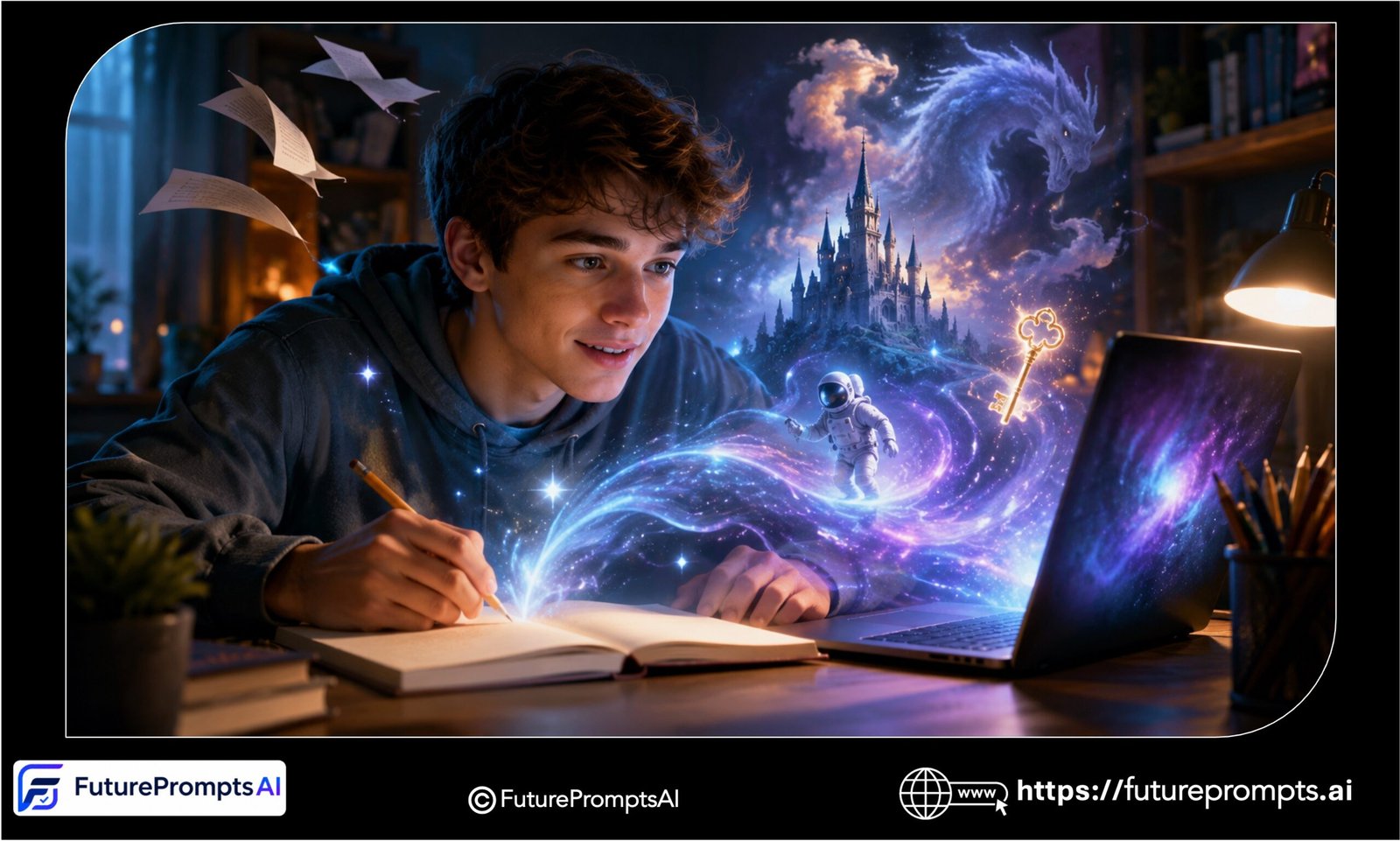
Turn imagination into structured, original writing with 10 detailed and customizable AI prompts created for students. This collection covers storytelling, character development, dialogue, poetry, world-building, historical fiction, description, ethical dilemmas, and interactive narratives. Every prompt includes editable fields and asks the AI for practical planning, examples, questions, and revision support.
What These Prompts Do
- Help students develop original ideas into characters, settings, plots, scenes, poems, and organized writing plans.
- Turn AI into a supportive writing coach that provides guidance and examples while encouraging students to create their own final work.
Tips for These Prompts
- Replace every [bracketed field] with specific details; unusual combinations usually produce more original results.
- Personalize the AI’s output with your own experiences, vocabulary, opinions, and revisions instead of submitting it unchanged.
How to Use These Prompts
- Choose a prompt, customize the bracketed sections, and paste the complete prompt into your preferred AI tool.
- Review the response, answer its follow-up questions, and request changes such as “make the conflict stronger” or “simplify this for Grade 7.”
10 Creative Writing AI Prompts for Students
Replace the text inside [brackets] before pasting a prompt into ChatGPT or another AI tool.
1. The Mysterious Object Story
Act as a supportive creative-writing coach for a [grade level/age] student. Help me develop an original [word count]-word [mystery/fantasy/adventure] story about a student who discovers [mysterious object] in [location].
The object appears ordinary, but it can [unusual ability or secret]. The main character wants [goal], while [person, creature, rule, or fear] stands in the way. The story should explore [theme, such as courage, honesty, friendship, or curiosity] and have a [suspenseful/funny/emotional/hopeful] tone.
Please provide:
- Three original story directions.
- A main character profile with a strength, flaw, motivation, and fear.
- A five-part plot: opening, discovery, complication, climax, and resolution.
- Three sensory details that make the setting vivid.
- One unexpected but believable plot twist.
- An engaging opening paragraph of no more than [100] words.
- Five questions that will help me continue the story in my own words.
- A revision checklist appropriate for my grade level.
Avoid clichés and do not write the complete story for me unless I specifically request it.
2. The Accidental Time Traveler
Help me plan a historical-fiction story for a [grade level/age] student. The main character is a student from [current year] who is accidentally transported to [historical period, event, or civilization] after [triggering event].
The character must complete [mission] before returning home, but changing one historical detail could affect the future. Include [historical person, place, custom, or invention] and focus on [theme].
Create:
- A brief, historically plausible description of the setting.
- Three possible time-travel rules and the consequences of breaking each one.
- Profiles for the student, a historical ally, and an opposing character.
- A seven-scene outline with rising tension.
- One moral decision with two difficult choices.
- Five period-appropriate details I could research or include.
- A dramatic opening scene of [100–150] words.
- Three possible endings: hopeful, surprising, and bittersweet.
- A checklist separating facts I should verify from fictional elements I may invent.
Keep the language suitable for [grade level] and clearly label anything that requires historical fact-checking.
3. One Event, Two Perspectives
Act as my writing coach and help me tell the same event from two contrasting points of view. The event is [argument, competition, discovery, accident, celebration, or other event], set in [location and time].
The two narrators are:
- Character A: [name, role, personality, and goal]
- Character B: [name, role, personality, and goal]
They disagree because [misunderstanding, secret, conflicting belief, or competing goal]. The story should be [word count] words and explore [theme].
Please produce:
- A comparison of what each character knows, wants, fears, and misunderstands.
- Five details that both characters notice but interpret differently.
- A parallel outline showing the event from each perspective.
- A distinct vocabulary, sentence style, and emotional tone for each voice.
- A [75–100]-word sample paragraph from each narrator.
- A key moment when the reader realizes neither character understands the whole truth.
- Three possible resolutions.
- A revision checklist for making the two voices clearly different.
Do not make one character completely right or wrong. Give both characters believable motivations.
4. The Dialogue-Only Challenge
Help me create a dialogue-only scene for a [grade level/age] creative-writing assignment. Two characters—[Character A] and [Character B]—are in [setting] and disagree about [conflict].
Character A wants [goal], while Character B wants [different goal]. One character is hiding [secret], and the truth should become clear through word choice, pauses, interruptions, and indirect clues. The scene should have a [tense/funny/awkward/emotional] mood and contain approximately [number] lines of dialogue.
Please give me:
- A short private motivation for each character.
- The information each character knows and does not know.
- A beat-by-beat plan for how the conversation escalates.
- A complete dialogue-only scene with no narration or dialogue tags.
- Natural interruptions, subtext, and distinct speaking styles.
- One turning point that changes the balance of power.
- An explanation of three places where the dialogue reveals more than it directly says.
- A revision exercise that helps me rewrite the scene in my own voice.
Keep the dialogue age-appropriate and avoid long speeches that sound unnatural.
5. Build a Future World
Act as a science-fiction world-building coach. Help a [grade level/age] student design a society in the year [future year], where [major invention, environmental change, or social rule] has transformed everyday life.
The story takes place in [city, planet, school, settlement, or other location]. The main character is [character description], who begins questioning [law, tradition, technology, or belief] after [inciting incident]. The central theme is [freedom, responsibility, identity, fairness, progress, or another theme].
Develop:
- A clear explanation of the world’s central idea.
- Details about education, technology, transportation, food, government, and entertainment.
- Three benefits and three hidden costs of this society.
- Five rules citizens must follow.
- A main character, ally, and antagonist with conflicting goals.
- A six-scene plot outline built around one difficult choice.
- Five invented terms with understandable definitions.
- A vivid description of one important location.
- Three endings based on different decisions by the main character.
- Questions that help me test whether the world is logical and consistent.
Make the world imaginative but internally consistent. Explain how each major feature affects ordinary people.
6. Retell a Familiar Tale
Help me create an original retelling of [fairy tale, myth, legend, or public-domain story] from the perspective of [minor character, supposed villain, magical object, animal, or overlooked witness].
Set the retelling in [modern school/future city/different culture/historical era/custom setting] and use a [humorous/dark/hopeful/adventurous] tone. Preserve [one recognizable element], but change [character role, central conflict, ending, or moral]. The new theme should be [theme], and the intended reader is [age or grade level].
Please provide:
- A short summary of the original tale’s essential elements.
- Five creative changes that make my version distinct.
- A profile of the new narrator, including what the original story misunderstood about them.
- A scene-by-scene outline for a [word count]-word retelling.
- Three references to the original tale that readers may recognize.
- An opening paragraph that immediately establishes the new perspective.
- One major reversal near the climax.
- Three possible new morals.
- A checklist for avoiding a simple copy of the original.
Use only the story details I provide or material that is safely in the public domain. Do not imitate the style of a living author.
7. Make a Setting Feel Alive
Act as a descriptive-writing coach. Help me write a vivid scene set in [location] during [time, season, or weather condition]. The character has just [arrived, discovered something, lost something, or made a decision] and feels [emotion], but I do not want to name that emotion directly.
The scene should be [word count] words, use [first/third] person, and have a [peaceful/eerie/energetic/melancholy] atmosphere.
Please create:
- A sensory bank containing specific sights, sounds, smells, textures, and tastes.
- Five setting details that subtly reflect the character’s emotion.
- Three original similes or metaphors suitable for [grade level].
- A plan showing how the setting changes from the beginning to the end.
- A model descriptive passage of no more than [150] words.
- An explanation of how the passage “shows” emotion without naming it.
- A weaker sentence followed by two stronger revisions.
- A checklist for removing vague adjectives, clichés, and unnecessary details.
Keep the description focused on details the viewpoint character would realistically notice.
8. The Science-Fiction Ethical Dilemma
Help me plan a thought-provoking science-fiction story for a [grade level/age] student. In this world, [AI system, robot, scientific discovery, or futuristic technology] can [ability], but using it may cause [risk or unintended consequence].
The protagonist is [character description] and must decide whether to [Choice A] or [Choice B]. The decision affects [person, community, environment, or society]. The story should be [word count] words and explore [privacy, fairness, responsibility, identity, trust, or another issue] without giving an overly simple answer.
Please provide:
- A clear explanation of the technology and its limitations.
- Three advantages and three dangers.
- The strongest argument for each choice.
- Four characters who represent different viewpoints.
- A seven-part plot outline that gradually reveals the consequences.
- Two clues that foreshadow a major complication.
- One scene where the protagonist’s beliefs are challenged.
- Three endings, each showing a different consequence.
- Five discussion questions for after the story.
- A revision checklist for balancing action, ideas, and character development.
Avoid portraying technology as automatically good or evil. Make every side of the dilemma understandable.
9. Extended-Metaphor Poetry Workshop
Act as a poetry coach for a [grade level/age] student. Help me write a [free verse/sonnet/ballad/spoken-word] poem about [subject or experience] using [object, place, season, or natural event] as an extended metaphor.
The poem should express [emotion or message], have a [reflective/hopeful/angry/playful] tone, and be approximately [number] lines long. I want to include [specific image, memory, phrase, or detail].
Please give me:
- Five possible connections between the subject and metaphor.
- A sensory word bank that avoids clichés.
- Three possible opening lines with different moods.
- A line-by-line structure I can follow.
- Suggestions for imagery, sound devices, repetition, and line breaks.
- A short model stanza—not a complete poem—that demonstrates the technique.
- Three questions that help me add personal details.
- A checklist for revising rhythm, imagery, word choice, and emotional impact.
Do not write the entire final poem unless I ask. Do not imitate a named living poet; use the general style features I select.
10. Create a Branching “Choose Your Path” Story
Help me design an interactive story for a [grade level/age] student. The reader plays [character or role] and begins in [setting] with the goal of [mission]. The main danger is [threat], and the reader has access to [tool, ability, companion, or clue].
The story should use a [mystery/adventure/fantasy/science-fiction] genre, a [tone] tone, and explore [theme]. It should contain [number] major decisions and at least [number] different endings.
Please produce:
- The rules of the interactive world.
- A short player-character profile.
- A branching structure in a clearly labeled text outline.
- Meaningful choices where each option has a benefit, risk, and consequence.
- Clues that reward careful readers.
- One opening passage of [100–150] words.
- Text for the first decision and its [two/three] options.
- A success ending, a failure ending, and a surprising ending.
- A continuity checklist to prevent contradictions between branches.
- Suggestions for expanding the outline into my own complete story.
Make choices affect later events. Avoid false choices that lead immediately to the same result.
About author


Add comment